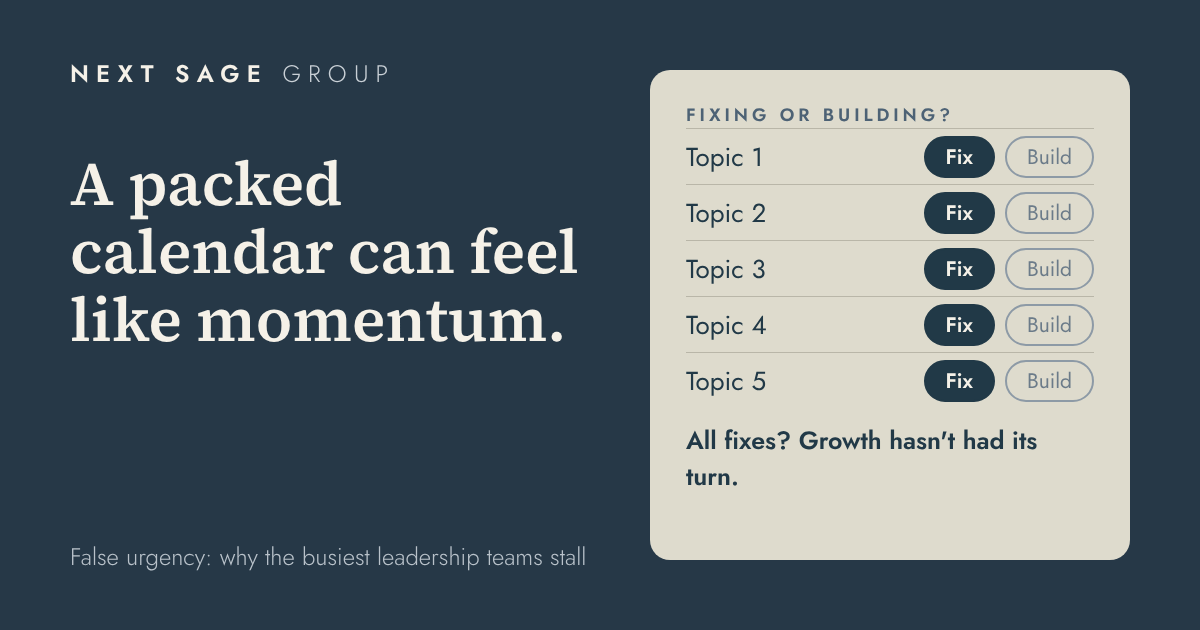
Some of the busiest Leadership Teams we meet are also the most stuck. The calendars are full, the meetings run long, and everyone works hard. A quarter later, the business is about where it was.
John Kotter gave this a name in A Sense of Urgency. He calls it false urgency, and it's one of the most useful ideas a Leadership Team can borrow.
False urgency feels like momentum
False urgency is activity driven by anxiety. People run from meeting to meeting, react to whatever is loudest, and produce a lot of motion. It feels productive. It rarely moves the few things that matter most.
Kotter sets it beside two other states. Complacency is when nobody feels much need to act. True urgency is a focused, steady push on the important work, every day, without the frantic edge.
Why it is so easy to fall into
Leadership Teams are full of capable people doing the work in front of them. Maximizing growth or finding the growth in your data might not be their focus. That's a strength, and it's also why false urgency is so easy to fall into: there is always another problem, and solving it feels like progress. (More on that in Why the growth levers are hard to see in your data.)
In teams that run on EOS®, the Issues List never runs dry. A team can spend every weekly meeting on real issues, finish every Rock, and still drift from the 1-Year Plan. Nobody did anything wrong. The urgency just pointed at the wrong things.
Three signs your urgency is false
1. Your last five leadership topics were all fixes
Look back at the topics that took real time in your last few meetings. If every one repaired something and none built something, the team is busy, not urgent.
2. Nobody can name what matters most this month
Ask each person which one thing most needs to move in the next 30 days. Different answers mean the team's energy is spread thin.
3. The gap to plan surprises you
If the team learns at the quarterly that revenue is behind, the urgency was never connected to the plan. True urgency watches the gap every month.
Turning busy into urgent
- Make the gap visible. Put revenue and profit against the Growth Plan in front of the team every month, with the gap in dollars.
- Name the one or two Growth Levers that explain it. Those become the team's focus until they move.
- Protect time for them. Give growth its own slot in the monthly review so the Issues List can't crowd it out.
- Stop something. Kotter's point is focus, not more effort. For every new push, decide what the team will stop doing.
A quick test
At your next leadership meeting, mark each of the last five topics: fixing something, or building something? If it's five fixes and no builds, you've found the reason growth keeps waiting.
To see how your company compares before you choose where to focus, take the Growth Benchmark. It takes about two minutes.
Compare your revenue per employee and profit margin with your industry in about two minutes.
Start the 2-minute check